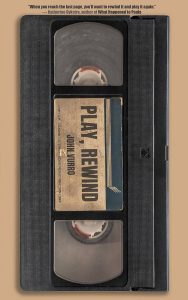
Play, Rewind by John Vurro

A Review by Jennifer Rivera

In Play, Rewind, John Vurro’s striking debut novel, readers are invited into the fragmented world of Wes, a twenty-six-year-old young man whose life has been reoriented around the slow unraveling of his mother’s mind. Vurro delicately balances narrative intimacy and structural sophistication, producing a work that is both emotionally affecting and formally ambitious. Set against the crumbling backdrop of a dying video rental store in Queens, New York, the novel is a meditation on memory, regret, identity, and the salvaging power of art.

Wes is introduced to us as a once-aspiring filmmaker now trapped in the liminal space between hope and responsibility. When his mother was diagnosed with dementia, he gave up his plans for film school to care for her full-time. The emotional cost of this decision, however loving, becomes the axis on which the entire novel turns. Wes is not simply a dutiful son; he is a young man increasingly defined by loss of future, of past, and of self. His mother, once his anchor, is now volatile and unrecognizable, her moods swinging sharply as her memory deteriorates.  Yet, Wes continues to maintain their home in its pre-diagnosis state, as if he can freeze time and prevent the erosion of her identity.

Vurro’s portrayal of dementia is remarkably grounded. Rather than romanticize the disease or turn it into a convenient metaphor, he presents it in all its harrowing mundanity: the constant repetition, the flashes of lucidity that only make the decline more painful, the emotional labor that never stops. Wes’s caretaking is both physically draining and spiritually exhausting. His only real support comes from Gloria, a compassionate and competent part-time nurse whose presence offers structure and a semblance of relief, even as the weight of the situation grows heavier.  She gently urges Wes to consider placing his mother in a home—an option he sees as both a betrayal and an impossibility, given their financial constraints.

A thread of mystery enters the novel when Wes discovers an unmarked videotape outside the store labeled “COPY DON’T WATCH. BE BACK SOON.”  The tape appears to be a simple home video of a couple’s Caribbean vacation, yet it becomes a powerful emotional and narrative anchor. What first seems incidental evolves into a deeply symbolic presence in the story: a glimpse into a life untouched by obligation, a visual embodiment of joy and freedom that stands in stark contrast to Wes’s own constrained existence. Vurro uses the footage not just as a clue, but as a catalyst. This artifact awakens something long dormant in Wes’s imagination and ultimately sets the story’s emotional and creative transformation into motion.

Wes’s emotional landscape becomes further complicated by the reappearance of Lola, a high school crush who disappeared without explanation just before graduation. She resurfaces as mysteriously as she vanished, offering neither clarity nor closure. Instead, she inserts herself into Wes’s life, posing as Joan, his mother’s long-deceased sister. Her role in the household becomes an unsettling performance, one that momentarily comforts his mother but ultimately disrupts the careful equilibrium Gloria has helped Wes maintain. Lola’s refusal to share her past and her tendency to sidestep caregiving boundaries create additional strain. Yet her presence also injects a kind of chaos that nudges Wes toward emotional risk—toward change.

Vurro uses Lola’s character as a reflection of Wes’s indecision and yearning.  Her mysterious past, her charm, and his intense emotions towards her all complicate the care ecosystem around Wes, forcing him to confront not only his mother’s deterioration but his loneliness.  Lola’s return and her impulsive efforts to help challenge Wes’s sense of control and his reluctance to look beyond the walls of his current life.  Lola’s presence also reintroduces the theme of escape. For Wes, the tape and Lola represent alternative lives: one imagined, one remembered, both infused with what-ifs.

The novel pivots when Wes decides to enter a film contest at the Manhattan Film School. With Lola’s help, he begins recording his mother’s daily life, interweaving this footage with the mysterious vacation video. The act of filmmaking becomes a vehicle for processing grief, confusion, and memory. In this way, Play, Rewind becomes not just a novel about film, but a novel structured like a film—editing together disparate pieces to create a coherent emotional narrative.

The documentary effort elicits a crucial confession from his mother: the truth about Wes’s father. Contrary to what Wes believed, his father never moved to Florida. Instead, after putting the family in danger due to gambling debts, his mother paid him to disappear. This revelation doesn’t just upend Wes’s understanding of his childhood; it exposes the fragility of the stories we tell ourselves to survive. Vurro handles this moment with quiet force, avoiding melodrama in favor of emotional authenticity.

Determined to uncover the truth, Wes tracks down the address on the lease his mother co-signed for his father. What he finds is both astonishing and painfully anticlimactic: his father, still living in New York, fails to recognize his grown son. In a further twist, Wes realizes the couple from the mysterious video—Greg and Sarah—are his father’s neighbors. The discovery is startling, but rather than wrap this coincidence in narrative certainty, he lets it remain ambiguous, inviting readers to consider whether fate, coincidence, or something more ethereal is at play.

As Wes grapples with these revelations, his caregiving responsibilities grow untenable. His mother injures Gloria, and Lola volunteers to stand in her place as caregiver.  After Lola impulsively takes his mother to a casino, resulting in a public disturbance and hospitalization, Wes is forced to confront the truth: he can no longer manage her care alone. In the novel’s most tender and mature turn, he makes the difficult decision to place his mother in a care facility. It’s a decision made not from abandonment, but from love—an act of courage that acknowledges both his mother’s safety and his own right to survive.

Vurro’s prose is unobtrusive but precise. The novel’s structure—layered with flashbacks, videotape footage, documentary scenes, and real-time struggles—mirrors Wes’s internal fragmentation and gradually reassembled self. The result is a story that feels deeply lived-in, like a memory being edited as it’s told.  What elevates Play, Rewind is Vurro’s stylistic control. His prose has clean, attentive, and unshowy qualities that allow the emotional weight of the story to build naturally. Dialogue is realistic and nuanced, often infused with a quiet ache. Cinematic imagery—unsurprisingly—is used with restraint, not flourish. The novel respects its characters enough not to impose meaning upon them. Instead, it invites the reader to sit in the discomfort of not knowing how long a loved one will remain recognizable, not knowing if a sacrifice will ever be rewarded, not knowing if art can truly redeem pain.

Ultimately, Play, Rewind is a novel about memory—how it fades, how it returns, and how it can be recorded, even remade, through the lens of love and art. Wes’s journey is not about reclaiming lost time, but about accepting what is and daring to hope for what might still be possible. In creating a film that blends fantasy and reality, Wes gives his mother and himself a kind of immortality.

This is a quietly powerful novel about letting go of the life you imagined in order to honor the one you’re living—and about the beauty that can emerge from the effort to preserve it.
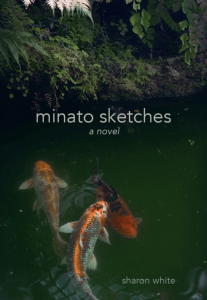


Minato Sketches by Sharon White

A Review by Mary Evangelisto Miller

When Gigi lands in Tokyo to begin teaching a summer-long art history seminar, she embarks on more than a professional appointment. Summer often serves as a bridge, especially for students and teachers, spanning the chasm between the end of one school year and the beginning of another. For Gigi, the summer represents even more: a rebirth. After a debilitating stroke, and years of rehabilitation, during which she was tasked with relearning how to perform basic functions—smiling, speaking, using utensils, word-finding—she is ready to reenter the world, outside the protective care of her family.

It is no accident that Tokyo is her destination. As a young student, Gigi’s period of study in Japan proved transformative, and an irresistible longing to return to that time while beginning the next phase of her life propels Gigi forward, despite her reservations. Trying life on her own, independent of her husband and sons, is the next step in her healing, as well as an attempt to reclaim something she lost inside her soul before the stroke caused her to lose her language. Postgirlhood, prestroke, Gigi lost sight of who she is beyond a wife and mother, and misses her fire, needing “this time to be a chance to reclaim some kind of wildness of spirit.”

As Gigi settles into what will be her life for the summer, she begins to reclaim herself through teaching, connecting with her students, and, in particular, through new friendships with colleagues—particularly Richard, a physics professor-turned-dance and yoga instructor. In her time off campus, Gigi explores various gardens and tends her own plants she has installed in her apartment. As the summer unfolds, her friendship with Richard becomes central to her life, as they spend many hours bonding while exploring Japanese gardens and parks together.

Recurring themes mirror the loss and renewal of Gigi’s health and vitality. Gigi frequently refers to her stroke as “lightning in her brain,” equating her medical emergency with a natural disaster. Likewise, the Japan of her youth has been transformed through the catastrophic earthquake and tsunami of March 11, 2011—a triple disaster involving a massive earthquake, devastating tsunamis, and the subsequent Fukushima Daiichi nuclear meltdown, leading to loss of life, displacement, and long-term environmental and social effects in the Tōhoku region. Tōhoku, too, is emerging from disaster; like Gigi herself, the Japan of her younger days is gone, but in the process of rising from the ashes. Still alive, but irrevocably changed.

In another metaphor for creating order from chaos, the work of Robert Smithson is mentioned throughout the novel. Smithson is best known for large-scale sculpture and land art; his focus was on transforming ruined or exhausted sites in nature into something new—much like post-lightning Gigi, or post-3/11 Japan. The wild boars that are thriving in the desiccated landscape in high-radiation zones in Sendai serve as another example of adaptation after a cataclysmic event. Gigi’s ongoing fascination, and eventual encounter, with these wild boars show her affinity for these creatures, which mirror her own strength and resilience.

Minato Sketches is a beautifully written novel. The fleshed-out descriptions of the gardens and flowers Gigi loves, as well as the still-recovering landscapes she visits, lend vitality to the text. The chapters are concise; like the still-recovering processes of Gigi’s brain, each chapter comprises sketches of time, rather than completed artworks. The voice and language are clear and simple. The multilayered structure of the novel creates interest throughout the novel as different elements of the story unfold. Through Gigi’s experiences, as well as the narrative, the reader learns details about Japanese culture and society that add heightened texture and meaning to Gigi’s experience.

In Japanese, Minato (港) means “harbor” or “port,” symbolizing safety, cultural exchange, and connection. The character 港 visually depicts water enclosed by structures, signifying a safe haven for ships. In Minato Sketches, for Gigi, the Tokyo summer is precisely that: a place of safety during her progressive healing; a place of exchange of what she was before the stroke for what she is becoming now; a place of new connections, not only with new people, but with Japan, as a metaphor for her own rebirth after disaster. As we follow Gigi on her journey, we are reminded of the fragility and power of change. What does not kill us may not necessarily make us stronger, but it will change us, and we must find a way to forge ahead.


Mary Evangelisto Miller is a freelance writer and editor based in Bucks County. She has been self-employed as a medical editor for 23 years. Mary holds a bachelor’s degree in Mass Communications and English from Temple University and a master’s degree in English and Publishing from Rosemont College.


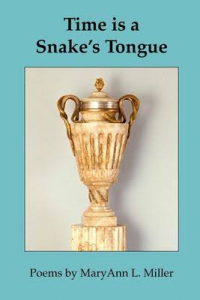
Time is a Snake’s Tongue by MaryAnn L. Miller

Review By Sarah Van Clef

MaryAnn L. Miller, in Time is a Snake’s Tongue, writes of a specific incident in a specific place and time in the author’s life, yet she reaches readers’ hearts with her words and images, which echo into our present day.

Birds are a favorite image of Miller’s. In several poems, they appear as high schoolers in a marching band walking in a parade, as survivors against the threat of overdevelopment; signs of the future. For example, a red-tailed hawk is driven from its territory by a housing development but returns to kill bunnies in a backyard in the poem called “Red Tail.”

Miller’s poems consider the impact of racism on an individual, adeptly merging scenes from the past with present consciousness. Her poem, “My Armor Is Silence,” encapsulates the sentiment of this chapbook: My verbs are wishes. / As long as I’m / quiet, I will be okay. / My mouth is shut / but my skin shouts.

Other poems reference prejudice in its varied forms. Miller also uses images of a bird to tell the story of a human in “Trans-specied.” The first stanza begins with a ‘tweet’ from the cradle. Later, the character jumps, ‘trying to get more air.’ Near adulthood, he grows ‘wings’ and a ‘feathered neck.’ Even though the nest calls to him, he flies, speaking with his ‘beaking lips,’ searching for the food of a hawk, ‘rodents, hatchlings, small bony fish.’ His transition is complete. There’s the suffering of Native Americans at the hands of deceitful white people, youth taunting the aged, and the fear of Communism knocking at the door during the Cold War. There are Catholic nuns frightening children, white Italian parents’ dread of a dark-complected child, and memories of racism that prohibited a neighbor from drinking from a family water glass.

Miller employs creative punctuation and line breaks, underscoring the social critique integral to the pieces. There is meaning between the commas and periods. There is meaning between the words that becomes recognized only by reading aloud. It takes some effort to understand the message, the truth in these words, these images, these poems. Just like it takes effort to recognize injustice, past, present, and ongoing.


Sarah Van Clef is a the Reviewers Editor of Philadelphia Stories. She is an Adjunct Professor in English Writing and Community Literacy across multiple colleges across New Jersey.

Circle of Hope by Eliza Griswold

Review By Beth Toner

To read Beth’s review of Circle of Hope, click HERE.


Beth Toner is a nurse, writer, and erstwhile theater nerd who still hasn’t figured out what she wants to be when she grows up. As a strategic communications professional, she has spent the last 30 years writing other people’s stories, and now she’s writing her own. She worked as a stringer for community newspapers early in her career, when 20 dollars felt like a fortune for sitting through municipal meetings and writing coverage only the township supervisors read. Her nerd’s heart is particularly proud of having her short story, “Homemade,” selected for publication in Star Trek: Strange New Worlds VI. She has written and performed several versions of her solo show, Beautiful Disasters, at the Reading (PA) Five-Minute Fringe Festival, the Harrisburg Fringe Festival, and Caveat in New York City. Beth is also a second-career registered nurse with a passion for exploring how storytelling can prevent professional burnout and improve patient care. When she’s not working her day job or volunteering at the local free clinic, you can find her walking trail races while younger, faster folks greet her with “good job!” and “on your left!” She lives in Pottstown, Pennsylvania with her husband and their son.

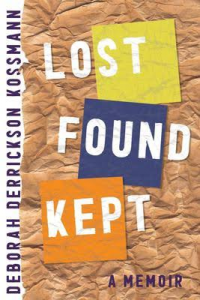
Lost, Found, Kept by Deborah Derrickson Kossmann

Deborah Derrickson Kossmann won Trio House Press’s inaugural 2023 Aurora Polaris Creative Nonfiction Award for LOST FOUND KEPT: A MEMOIR (January 2025). Book Pages named it one of the Best Memoirs of 2025. Her essays, feature articles and poetry have appeared in The New York Times, Bellevue Literary Review, Nashville Review, Memoir Monday, Psychotherapy Networker and PSYCHE to name a few. Deb is a clinical psychologist who lives in Havertown, PA. For more info: http://lostfoundkept.com


Review By Jennifer Rivera

Deborah Derrickson Kossmann’s Lost, Found, Kept is an exceptional memoir that blends unflinching honesty with such tenderness that you come away not only knowing the author’s story but feeling it in your bones. At its surface, this is a book about confronting a parent’s compulsive hoarding and all the logistical, financial, and emotional chaos that comes with it. But beneath that is something far richer: a layered exploration of love, family bonds, boundaries, and the objects, both literal and symbolic, that tether us to our histories.

From the opening pages, Kossmann draws us into her dual role as both a clinical psychologist and a daughter caught in an intricate web of loyalty and frustration. She doesn’t shy away from showing the reader the grim realities of her mother’s home: the overgrown yard, the blocked windows, the absence of running water, but she never reduces her mother to her illness. Instead, she paints her as a multifaceted, often witty, sometimes infuriating, but ultimately human figure who shaped Kossmann’s life in profound ways. This balance between exposing hard truths and maintaining compassion is one of the memoir’s greatest strengths.

The book is divided into three sections, “Lost,” “Found,” and “Kept,” which reflect the arc of Kossmann’s emotional and practical journey. In “Lost,” we get vivid childhood recollections from growing up in Cherry Hill, New Jersey, to the move from one house to another, and the complicated dynamics with her father, stepfather, and sister. Kossmann’s vividly described details bring these memories to life, whether it’s the smell of her mother’s Wind Song perfume or the exact shade of pink shag carpeting in her teenage bedroom. These scenes not only ground the reader in time and place but also reveal the roots of the family patterns that later manifest in the hoarded home.

In “Found,” Kossmann shifts into the present-day urgency of managing her mother’s unraveling situation. Here, the memoir takes on the rhythm of a real-time crisis, as she and her sister navigate unpaid bills, disconnected phones, and long-shut-off utilities. Her professional training as a psychologist helps her maintain a certain level of calm, but Kossmann doesn’t hide the toll it takes. She finds humor in these moments, too, a dry, knowing wit that keeps the narrative buoyant even though the circumstances are grim.

“Kept” is arguably the most moving section, in which Kossmann reflects on what’s worth holding onto.  Not just in terms of physical belongings, but also memories, values, and relationships. She takes inventory of the items from her mother’s house that matter to her: childhood photographs, a four-poster bed, family jewelry, and pieces of art with personal history. These tangible keepsakes become metaphors for the emotional throughlines of the memoir. In choosing what to preserve, she models for the reader how to honor the past without being consumed by it.

What makes Lost Found Kept especially compelling is Kossmann’s narrative voice. She writes with a kind of intimate clarity that makes the reader feel trusted, as though they’ve been invited not only into the family’s living room, but into the guarded spaces where family stories are kept under lock and key. Her prose is graceful but never flowery, sharp when it needs to be, and suffused with empathy even when her patience is tested.

While hoarding has been examined in popular culture, often with a sensationalist or voyeuristic lens, Kossmann’s memoir refuses to exploit. Instead, it offers a rare and humane perspective that acknowledges the pain of mental illness while still recognizing the agency and dignity of the person living with it. She doesn’t pretend that love makes the cleanup easier, nor does she suggest that resolution is neat or complete. Instead, she leaves space for the reader to sit with the mess, both the physical disorder and the emotional turmoil, to appreciate the strength required to face it.

The final pages of Lost Found Kept leave the reader with a quiet sense of hope. Not from a tidy fairy-tale ending, but a steadier kind born from doing the hard work of showing up, setting boundaries, and choosing what to carry forward. The memoir lingers, not just for its story but for the way it challenges the reader to reflect on their own “lost,” “found,” and “kept.”  What people, places, and possessions define us.

Deborah Derrickson Kossmann has crafted a memoir that is at once deeply personal and universally resonant. It’s about hoarding, yes, but it’s also about survival, forgiveness, and the enduring threads of connection between a mother and daughter. Honest without being cruel, emotional without tipping into sentimentality, Lost Found Kept is a beautifully written testament to the idea that in the wreckage of the past, there are still treasures to be found.


Jennifer Rivera is a Latina writer and certified dog trainer. She received her MFA in Creative Writing from Monmouth University in May 2024. Her prose and poetry have been featured in The Monmouth Review.

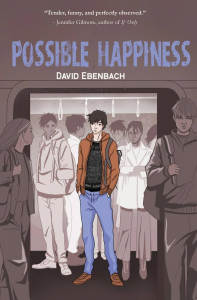
Possible Happiness by David Ebenbach


Photo of David Ebenbach by Justin Gellerson

Reviewed By Mary Miller

In 1989, junior year, Jacob Wasserman would be transformed from a quiet, shy, and, in his own estimation, “two-dimensional” loner to a member of The Pack. In the fluid manner of teenage relationships, a well-timed joke leads to a new friendship, which leads to a last-minute party invitation, which ultimately engenders the formation of a friend group that will become the focus of Jacob’s life, along with the inevitable group drama, romantic entanglements and jealousies, competition, and power struggles. Unspoken roles and responsibilities are fluid, and change quickly and often without a clear cause or purpose. The one nonnegotiable is loyalty to the group. Jacob, with a fractured family and limited social experience, is particularly in need of and vulnerable to the kind of togetherness The Pack implies.

The Pack is solidified, and complicated, through before-school hangouts, marathon evening telephone calls, parties thrown and attended, and nights on the dance floor at the iconic alternative/punk club Revival, whose siren song drew hordes of Gen X teenagers and young adults to the city in the late 1980s and early 1990s, and which provided a venue for all the drama, angst, and, as Ebenbach aptly describes in a running theme throughout his novel, the happy/angry joy/rage embodied in much of the music of that time.

His increasing enmeshment in The Pack leads to challenges for Jacob. He wants to maintain his pre-Pack work friendships, but is not sure how to do so. He is drawn to one girl in The Pack, but so are others—including his closest friend. The economic differences between Pack members are stark. Inevitably, the Pack members pair up into couples, either by desire or default, threatening the integrity of their bond. At the same time, Jacob needs to navigate his pre-Pack world, which is marked by complex family relationships, self-doubt, and debilitating anxiety. Belonging to The Pack, and having his first serious girlfriend within its confines, sometimes felt healing, yet sometimes led to new struggles that awakened Jacob’s anxiety, when he “would feel a keen howl of loneliness; or he would walk down his street and suddenly wonder whether he belonged there; or he would just wake up feeling a sense of being disconnected from the world.”

In Possible Happiness, Ebenbach provides a visit back to the high-school years, and for those of us who were Philadelphia-area teenagers in the late 1980s or early 1990s, reading this book is like stepping into a time machine. It rings true. Younger readers, as well as older ones, will connect with the narrative as well. This insightful coming-of-age novel provides a timeless look at that strange era in all of our lives of inevitable change, when we try on personalities like clothing while we try to figure out what feels right as we decide who we are going to be, and our friendships define us more than do our families. The writing is honest; the characters feel like people we know, or knew.

There are few seasons of life as consequential and poignant as the high-school years. Life for a t  teenager is full of confusion, marked by periods of clarity; sadness, punctuated by moments of joy; and isolation, highlighted by sporadic episodes of belonging. Not only the inner demons unleashed during this time, but also myriad outer forces, define these years: imperfect families, social minefields, treacherous high-school halls. The friends made in those years shape us and reveal us; they change us, sometimes dramatically, sometimes rapidly. Despite widely varying experiences, locales, and encounters, there is one universal: the high-school years, and those with whom we spend them, are transformative.

In a recurring theme, Jacob has always wondered what lies at Fern Rock station. He has never taken the train that far, but he has always wondered, with such a bucolic name, what would be at the end of that train line: an actual rock blanketed by ferns? More city? Something else? Yet in the end, how much does it matter? As with this point in time in Jacob’s life—an unfinished time of evolution and change, during which “he couldn’t help feeling that he was still very much getting to know himself, and that there was probably a lot more to come”—the mystery may be an inextricable element of its essence.


Mary Evangelisto Miller (left) is a freelance writer and editor based in Bucks County. She has been self-employed as a medical editor for 22 years. Mary holds a bachelor’s degree in Mass Communications and English from Temple University and a master’s degree in English and Publishing from Rosemont College.


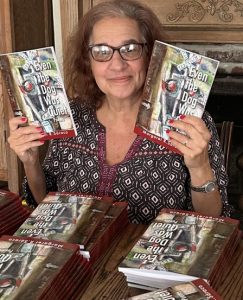
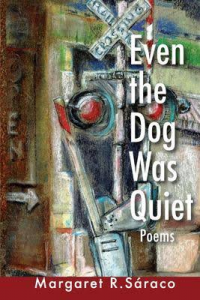
Review: Even the Dog Was Quiet by Margaret R. Sáraco


Review By: Nicole Conti

In Even the Dog Was Quiet, Margaret R. Sáraco crafts a haunting and emotional collection of poems that delve into the fragility of memory, the weight of loss, and the resilience of love. From the very first moments, the book establishes a poignant tone with jarring imagery of a burning house, a powerful metaphor for the slow, inevitable destruction that time and loss inflict on everything we hold dear. Yet, in the face of such loss, what remains is memory. Throughout the collection, Sáraco reflects on how love—whether for family, fleeting lovers, or friends—lingers in the fragments of memory we preserve, like echoes of a once-thriving home now reduced to ash. Her poems emphasize the importance of remembering, of holding onto the pieces of our past that define us, even when everything else is lost.

In reference to The Unlocked Door, Sáraco’s poetry serves as a “dose of fresh air cleansing a complex world.” Her work focuses on small, flickering moments, whether jagged with grief or buoyed by the sweet imagery of fruit, wine, and morning glory elixirs. These moments allow the reader to fully immerse themselves in her world, where each memory is carefully dissected and preserved. Sáraco grabs these small moments, milks every detail, and then delicately lays them out on the page, using beautiful poetic devices and vivid sensory elements. In many ways, her poems form a kaleidoscope of personal moments, frozen in time. She alludes to this in the poem Tall Ships, where she writes, “a moment in time caught with oils on canvas or a poet’s words.”

Sáraco skillfully orchestrates these themes of loss and love with mood. Take, for instance, the contrast of frigidness and warmth in Bobby and the Bonfire. The poem captures a heartbreak that shifts into a heartwarming end—the coldness of young heartbreak dissolving into warmth when the speaker gifts a ring to her future daughter. In ‘Between the Sheets’, the mood is heavy, cold, and sharp, underscoring the tragedy of loss with lines like:
“His words fall on our bed, gray shards
now next to my inexperienced and young body, mournful and
scared.”

Here, the sharpness of grief and regret is palpable. The poem’s coldness contrasts sharply with the warmth of memory in ‘Pink Hula Hoop’, where, despite the surrounding grayness, a glimmer of hope in the memory of her son’s childhood toy glistens, high up in the trees. It is a reminder that, even in the most somber of memories, brightness and hope can emerge.

Saraco’s writing is also glazed with poetic devices that further the beauty of these moments. The line “the day she dies in her sleep” demonstrates her skillful use of sibilance and alliteration, a technique she’s perfected throughout the book, as seen in phrases like “Slicing flesh… wrapping pounds of fillets in wax paper and plastic wrap while sweat drips down her face.” Some of her other notable uses of alliteration include “sun-starved skin,” “boots, battling bluefish,” and “disease disrupting our days.”

With the ‘End So Close, We Only See Beauty’ is another example of Sáraco’s brilliance, particularly in her metaphor of the bright green parakeet, stark against its sterile environment, “monochrome of confinement.” It echoes her mother’s vibrant spirit, which stands in sharp contrast to the cold, limiting space around her. In ‘Cookies’, Sáraco taps into sensory detail with lines like, “it’s filled with brown and black shoes that smell like grandma’s old leather bag left out in the rain.” This sensory detail pulls the reader into a world where memory and the senses are inextricably linked.

Beyond memory and love, Sáraco touches on other significant themes, including the struggles of an immigrant family and feminism, particularly in Dear So and So, where she explores the myths designed to keep women compliant. The collection traces the threads of girlhood and womanhood, showing how they intertwine throughout life.

In Recycle, 2017, she ponders, “Why do I despair amid such beauty?” The book itself answers this question: we despair from beauty. It’s the pain that spills from love—the beauty of it, but also the great despair in its loss. This is why remembering is so important: because, in remembering, we hold onto the beauty of love and the pain of its absence.

In the title poem, ‘Even the Dog Was Quiet’, Sáraco teaches us the value of memory, not just as a means of preserving the past. The speaker writes everything down so the heart can remember when the mind has forgotten. Through this collection, Sáraco shows that memory is all we have left when everything else is gone. Toward the book’s conclusion, she reflects with envy on her son’s precise memory and muses about how we will all be reduced to “reminders of life’s past.” In this reflection, there is an irony: Sáraco, herself, has created a lasting memorial—Even the Dog Was Quiet—a book of memories that will endure long after the moments they describe have passed. In Sáraco’s own words, “Really, we are here for a moment, and then we are gone.” But her work has left many of her memories- which deserve to be remembered.


Nicole Conti


Review: In the Museum of My Daughters’ Mind by Marjorie Maddox


Review By: John Sweeder

Majorie Maddox’s chapbook, The Museum of My Daughter’s Mind, is a collection of 34 ekphrastic poems that were originally inspired by the author’s 2018 visit with her studio-artist daughter, Anna Lee Hafter, to Baltimore’s American Visionary Art Museum’s (AVAM) exhibition entitled The Great Mystery Show.  Influenced by her daughter’s subsequent artwork, Maddox features 18 of Anna Lee’s surrealistic paintings as well as the mixed media, photographs, and paintings of six other contributing artists, several of whose works have also appeared in the AVAM.

Maddox’s poetry explores the themes of positive human relationships, both interpersonal and intrapersonal, as well as the significance of imagination and creativity, improvisation, memory, nostalgia, grief, isolation, and alienation. Incorporating many of the repeated images contained in eighteen of her daughter’s surrealist paintings, Maddox embeds visual symbols—often numbers and letters, words and brief phrases, as well as concrete images and symbols such as chairs, chessboards and sunlight into her poetry, thus melding visual art with poetic language in an emotive symbiotic dance to deepen illustration her relationship with her daughter’s creative process.

In her pantoum, “The Choice,” Maddox uses her daughter’s visual metaphor contained in Hafter’s painting entitled “The Library” to explore one’s intuitive imagination using bibliographic tools—books, bookcases, floors, and ceilings—to seek truth, “The ancient why of creation”—all the while purporting that there is no set path to take in the pursuit of knowledge since we, “hold the pen and paintbrush” to create our own “Open Sesames.” The poem’s narrator further proposes that we not fret about making poor decisions since “splatter[s are] choices, not… mistake[s].”

In “High Top” Maddox, responds to her daughter’s surrealistic painting of the same name. Both artist and poet engage in an imaginary conversation as if seated across from one another in empty chairs separated by a table and chessboard, all of which are precariously balanced upon a seesaw, a “compass-needle pole.” The narrator-poet-mother asks her daughter: “Are we still we in this unseen grief/that keeps trying/ to listen to soul/ and scream?” Anna responds with her metaphorical “King’s Pawn Opening.” The two opponents in this fantasy chess match are unsettled for the moment, suggesting an estranged relationship. Yet, because of their long family history (“knee-deep in nostalgia”), a reproachment has begun: Mother “can almost see [her] breath;/ daughter “can almost touch [her] words.” Their unspoken grief remains on the table unresolved; however, both are “waiting for [each other’s] next moves.”

A lighter, more optimistic tone is struck in Maddox’s poem, “Sun on South Street.”  In this straightforward pantoum, the narrator enables us to imagine what life is like living in a “small quiet room” in a “Big busy city.” Exploring the contrasting themes of isolation versus “camaraderie” and light versus “dark,” we learn that days can be “brightened by the waves of strangers,” “the neighborly sun,” and “outside flowers” on balconies displayed for all to enjoy.

Hafer’s painting, “The Letter E” is an abstract tribute to the creative, right-brained random learner who does not “absorb new information” in a rigid sequential manner. Maddox adapts the theme of her daughter’s work to create an ironic poem of the same name whose narrator morphs into the didactic elementary school teacher we all recognize, the anachronistic school marm who proclaims, “Creativity’s the one transgression/ I won’t allow,” further arguing that curiosity and extraneous questions are no more than “time-wasting, silly digressions…[and] enemies of order.”

Maddox is inspired by the “tender but unsettling portrait” of a pig-tailed pre-pubescent girl holding a black cat, painted by Margaret Munz-Losch. In Maddox’s poem, “Black Cat,” a third-person omniscient narrator tells us that we, as unwanted voyeurs (perhaps the girl’s parents), enter her “stark room.” The anthropomorphized cat she cradles in her arms stares at us with its “bright feline eyes” thinking she doesn’t want us there. The girl’s dull skin squirms like a “pattern of maggots,” her eyebrows are perched like flies above her “dead-sea eyes,” and her tied-up hair is uncombed — all of which the narrator tells us we “cannot see.”  These imagined attributes are symbolic of the alienation that many young preteens experience—that is, they want (and maybe need) their own space to develop and mature. Thus, in the lives of young tweens we adults become as welcome as an “infested larvae of plague” hatching into them.

Maddox’s final poem, a sestina with the oxymoronic title, “Wild Rest,” was inspired by her daughter’s painting of the same name. In this work, the narrator begins by posing and answering the following question, “What does it mean to rest…in “a world so wild?” Maddox claims that through daily measured breathing, relaxed contemplation in a “well-worn chair,” and reliance upon our imagination, we should let our mind “wander out amidst the trees.” By exploring a “paradox of renewal,” we learn that “passive breezes [can] become wind” and that “rest [can become] a carnival tour of the spontaneous,” replete with roller coaster rides, fun houses, and Whack-a-Mole games. Maddox wants us to “Be still and know” and recognize “that breath and wind are cousins.”

As careful readers of literature, we are drawn to Maddox’s chapbook for a few reasons.  First, we readily identify with her motivation in creating this work. In her book’s introduction, “Entering the Gallery,” she tells us directly that she is “looking to escape [her] fears” of dying prematurely from heart disease and wants to spend the remaining time she has left with her daughter.  Many of us identify with this sense of urgency in reconnecting with loved ones while we still can. Time is both short and precious. Next, like Maddox and her daughter, we too enjoy visiting art museums, even small, intimate ones that may contain only a modest number of paintings like the ones in this chapbook. But when art and poetry challenge us to look and read more closely, when art and poetry become melded together, our aesthetic experience is enhanced. Through Maddox’s skill in creating the impressive array of interpretive poetry contained in this collection—poetry that ranges from free verse to sestina, poetry that utilizes the evocative tools of sensory imagery, metaphor, repetition, alliteration, internal and end rhyme—we want to seek out more of her work, and trust that she remains with us for years to come, continuing to engage creatively with her artful daughter, carrying on the centuries-old tradition of ekphrastic poetry.


John Sweeder


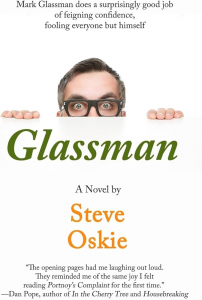
Review: Glassman by Steve Oskie

Review By: Margaret R. Sáraco

In this semi-autobiographical novel that takes place in Philadelphia and on the Jersey Shore, author Steve Oskie and his main character, Mark Glassman, have much in common: both dropped out of college, have the same taste in music, grew up in Philadelphia, and worked many jobs.

Mark’s journey to adulthood will keep a reader engaged while scratching their heads about his aimlessness. He works a series of odd jobs he is unqualified for, though sometimes he has a talent for something that surprises Mark and the reader. One of his prospective employers remarks in the novel saying, “Is it kosher for me to fire you before you start the job?”Clearly his resume turns into a document of failures.

During off hours, Mark imbibes enough recreational drugs and alcohol to keep himself numb. He fancies himself as a writer, something that simmers throughout the novel but comes across as a real chore to get him motivated. Mark seems to be a smart man with a lot of dumb ideas. Mark educates himself by reading and analyzing Philip Roth Portnoy’s Complaint, The Universal Baseball Association (a novel by Robert Coover), and The Sorrows of Young Werther by Johann Wolfgang von Goethe. During an amusing exchange, he gets caught by his foreman on a construction site reading Goethe’s novel during his lunch break.

Oskie lets the reader see the inner workings of his main character, who can shatter like glass. Mark pursues two women at the same time, although when dealing with women, words like terror and horror come to his mind. At first, his eye set upon Sarah Sloane. He then falls in love with Teresa Devlin, then ping-pongs his affections back to Sarah while more women enter and depart. At one point, Mark reflects: “I was still under the impression that I would never get anywhere with women simply by being myself, taking a genuine interest in them, and becoming a good person.” His fear of relationships harkens back to his parent’s divorce years before and the resulting trauma. He makes it his mission to disassociate himself from his parents and their expectations.

Mark can’t and won’t grow up, however, readers can’t help rooting for him. Because everyone in some aspects of life refuses to grow up too, readers patiently wait to see if Mark will figure out his life. While this coming-of-age story takes the character longer than most to mature (Mark’s mother would agree), Glassman is worth the wait.


A writer, spoken word artist, and activist, Margaret R. Sáraco taught middle school math for 27 years before publishing her poetry books, If There Is No Wind and Even the Dog Was Quiet with Human Error Publishing. She is a poetry editor for the Platform Review, an online literary journal.


ONLINE Bonus – Book Review: House Parties by Lynn Levin

House Parties by Lynn Levin

Review by Regina Guarino


House Parties is the debut short story collection of Lynn Levin, an established poet and English faculty member at Drexel University. In this 443-page collection, each of the 20 stories tell of the ordinary lives of ordinary people in search of connection. In her poetic use of language and her tender execution of character, Levin shines with her appreciation of our common humanity.

Her use of beautiful syntax, images, and metaphors elevates the tone of these masterful glimpses into character’s lives. Poetry shines through the stories, in lines that live in the imagination and beyond the page. Descriptions delight the senses and convey the beauty of humanity through the beauty of language.

In Little Secrets an English instructor yearns to reconnect with her former poet/professor lover, describing their relationship “as split and withered as a dead squash vine, and he would come to trample on its remains.” With stunning irony, the story ends, that connection dead despite her best attempts, but with another blooming.

Baby and Gorilla presents the story of a former addict with a criminal record, working in a gorilla costume, meeting a teen mom “bug-eyed, jumpier than a grasshopper, high as the moon.” Her voice is “hot with menace. Her gaze is like the muzzle of a gun.” Yet, in another ironic ending, this encounter becomes the one in which the gorilla-costumed man finds connection.

The Dirty Martini is a memorable story of a middle-aged man who seeks respite from the boredom and resentment he feels in career and marriage. Following the lead of a roguish colleague, the man makes one bad decision after another and runs into predictable trouble after predictable trouble. Because of Levin’s nimbleness in drawing motivation of the man, his wife, and his friend, we feel sympathy for him, as he seeks to fulfill his need for humanity in a self-defeating manner.

The lonely rabbinical student in Frieda and Her Golem seeks connection even as she guards her solitude. She learns how to imbue a substance like river clay or ground meat with life and creates a helpmeet to fulfill her need for a partner. Ironically, the Golem develops more and more the ability to relate to people out in the world, something Frieda herself cannot manage.  Finally, when the Golem takes on a mind of her own, Frieda must take drastic action.

Evermay Blair tells the story a teacher, so wrecked with guilt that he becomes ill and changes his lifestyle. He says, “A storm of blackbirds banged inside my head.” Yet the connection he needs, with his conscience, with another human being eludes him. Levin’s skillful narration evokes tenderness in our hearts for him.

Each story in this collection makes a fascinating read. The characters make decisions they know to be not quite right, yet they are compelled to do so anyway. In the end there comes no happy ending for them. But there is a gentle landing.  And, by the end of the collection, for the reader a profound appreciation of human nature.


Lynn Levin is a poet and writer. She is the author of nine books, most recently, her debut collection of short stories House Parties (2023). Widely published as a poet, Levin’s five poetry collections include The Minor Virtues (2020); Miss Plastique (2013), a Next Generation Indie Book Awards finalist in poetry; Fair Creatures of an Hour (2009), a Next Generation Indie Book Awards finalist in poetry; Imaginarium (2005), a finalist for Foreword INDIES Book of the Year Award; and A Few Questions about Paradise (2000). She is co-author, with Valerie Fox, of Poems for the Writing: Prompts for Poets (2019, 2013), a Next Generation Indie Book Awards finalist in writing/publishing. She is the translator, from the Spanish, of Birds on the Kiswar Tree (2014), poems by the Peruvian Andean poet Odi Gonzales. Levin is also the producer/director of the 2017 video documentary Life on the Napo River: A Glimpse of the Ecuadoran Amazon, Its People, and Their Traditions.


Regina Guarino (left) is a writer with an MFA from Drexel University. She formerly studied linguistics and instructed learners of English as a second language. She lives in Delaware with her cute dog, Chipita. Her interests include languages and cultures, gardening, and herbal remedies.